
Museum name: North Lincolnshire Museum
Location: Scunthorpe
Spotlight on: Research
A 2019 study revealed an unusual grave from Fonaby Anglo-Saxon cemetery. It was that of a young woman, buried with rich grave goods. Analysis of carbon and nitrogen isotopes in her bones indicated that she had a different diet to the local population and may therefore not have been from this area.
The Story:
Isotopes are different forms of the same element that share the same number of protons but have different number of neutrons. Isotope ratios vary between different environments and different food types, so measuring the ratios within someone’s bones or teeth can tell us about the person’s diet and the place they lived in.
In this case, analysis of the isotopes in the Fonaby woman’s skeleton indicated that her diet was significantly different to that of the other skeletons examined. It contained a higher than average amount of protein and a lower than average amount of seafood. She also appeared to have been eating different types of carbohydrates to the people around her.
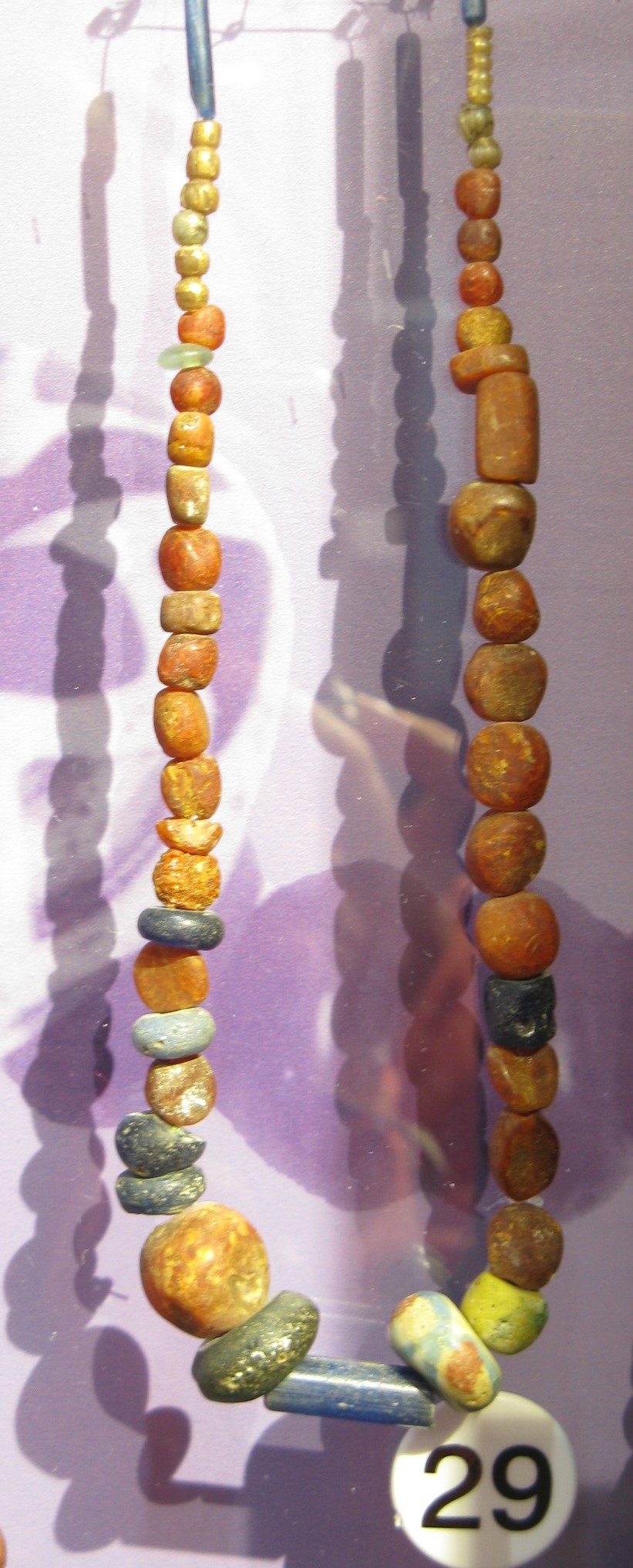
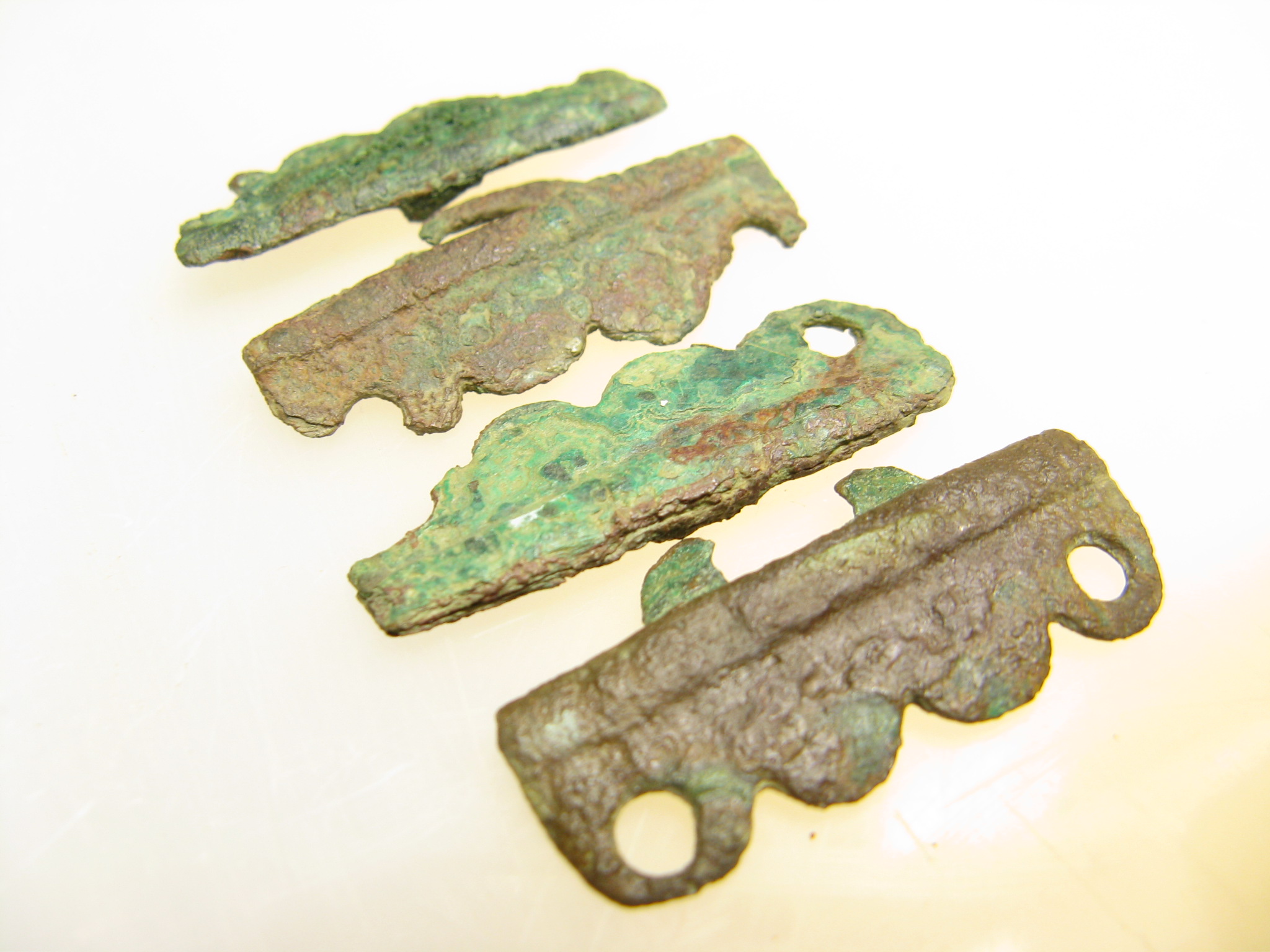
The most likely explanation for this is that she was a non-native, a theory that is supported by her grave goods. Among other high status objects, she possessed a collection of sleeve clasps which had been linked together to be worn around her forehead. This is a fashion most commonly seen in Kent. As Kentish fashions were often inspired by those of the continent, this means that she may have been either from Kent or from western Europe.
Further reading:
Fry, Megan H., Katie Libby, George Kamanov and John Krigbaum. 2019. Social Differentiation and Identity in the Anglo-Saxon Kingdom of Lindsey. Unpublished Master’s thesis, University of Florida.
Research:
Additional research carried out after the 2019 study has served to complicate the Fonaby lady’s story. Her tooth enamel was tested for oxygen and strontium. Unlike bone, tooth enamel is not remodelled once it has formed, so analysis of the isotopes within it can tell us where an individual lived during their childhood.
The Fonaby lady’s strontium values indicated that she could have been from the Humber region, although they were also consistent with parts of south-eastern England. Her oxygen values, in contrast, suggested that it was more likely she had grown up on the southern coast. Her carbon values, however, were not consistent with those from Kent, so work is still ongoing to investigate her origins. The most likely explanation of these results is that she was non-local, but other possibilities include disease, dietary restrictions due to illness, or factors such as social status or occupation affecting her diet.
This study is not only providing an insight into the life of this individual but may also provide us with more of an understanding of the community as a whole. This is especially valuable considering the circumstances under which Fonaby Anglo-Saxon cemetery was found.
It was discovered in the summer of 1956 during sand extraction works. Museum staff carried out rescue excavations on the site between 1956 and 1958, recovering a total of 49 graves and at least twelve cremations. A combination of difficult excavation conditions, poor preservation and unrecorded digging means that it is likely much of the cemetery has been lost.
Further reading:
Cook, A.M. and S.C. Hawkes. 1981. The Anglo-Saxon Cemetery at Fonaby, Lincolnshire. Occasional Papers in Lincolnshire History and Archaeology
Evans, J.A, J. Montgomery, G. Wildman and N. Boulton. 2010. Spatial variations in biosphere 87Sr/86Sr in Britain. Journal of the Geological Society 167 (1): 1-4
Leggett, S. (2021). ‘Tell me what you eat, and I will tell you who you are’: A Multi-Tissue and Multi-Scalar Isotopic Study of Diet and Mobility in Early Medieval England and its European Neighbours (Doctoral thesis). https://doi.org/10.17863/CAM.63545
Pellegrini, M. et al. Tooth enamel oxygen “isoscapes” show a high degree of human mobility in prehistoric Britain. Sci. Rep. 6, 34986; doi: 10.1038/srep34986 (2016).
Recent Comments